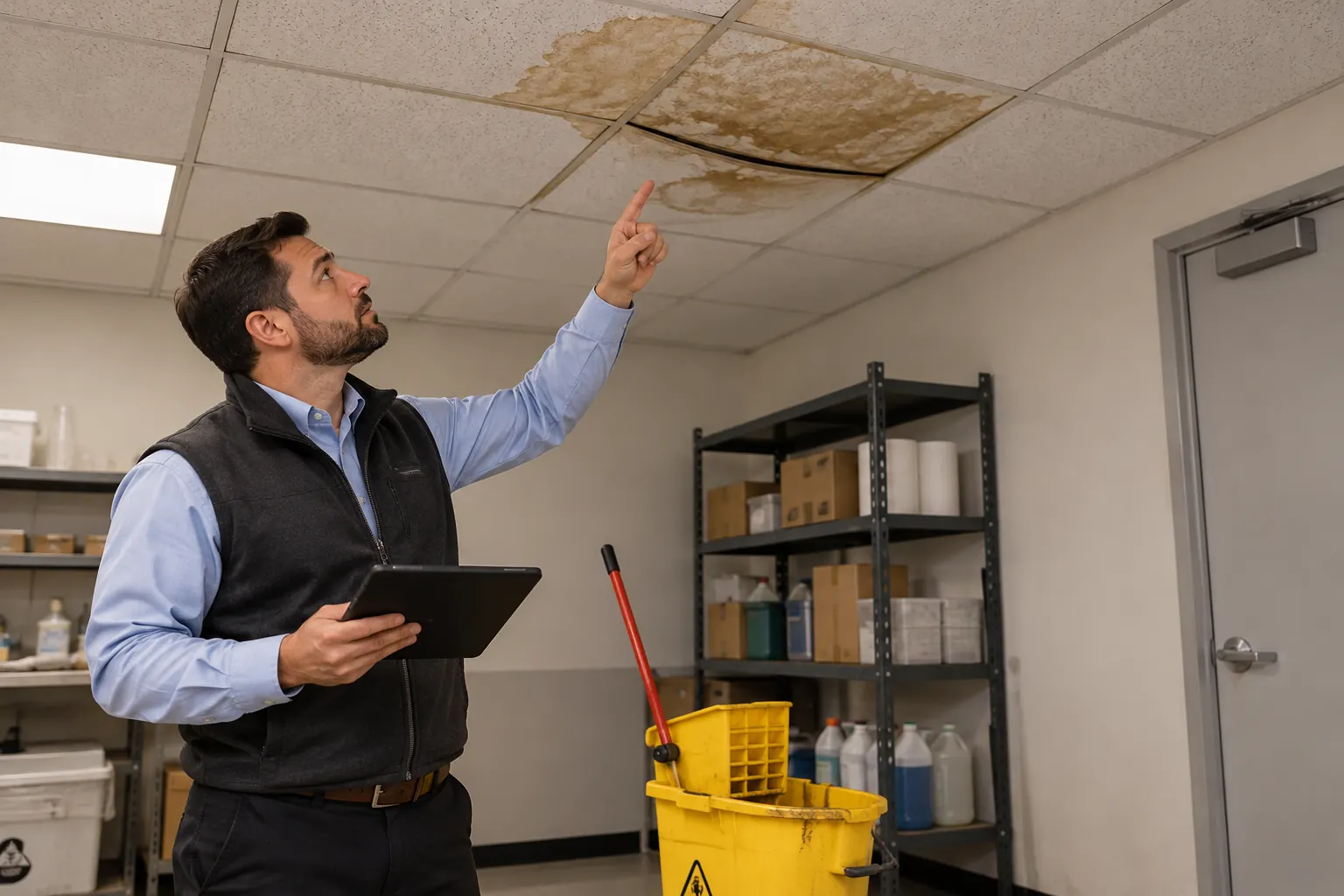
Commercial Roof Leak Repair
When the stain inside sits several bays away from any obvious flaw, leak tracing finds the lap or flashing before the flat roof repair begins.
Commercial roof leak repair
We repair flat roofs on Casa Grande warehouses, stores, and offices, fixing the seams, drains, scuppers, and flashings where low-slope membranes let water in.
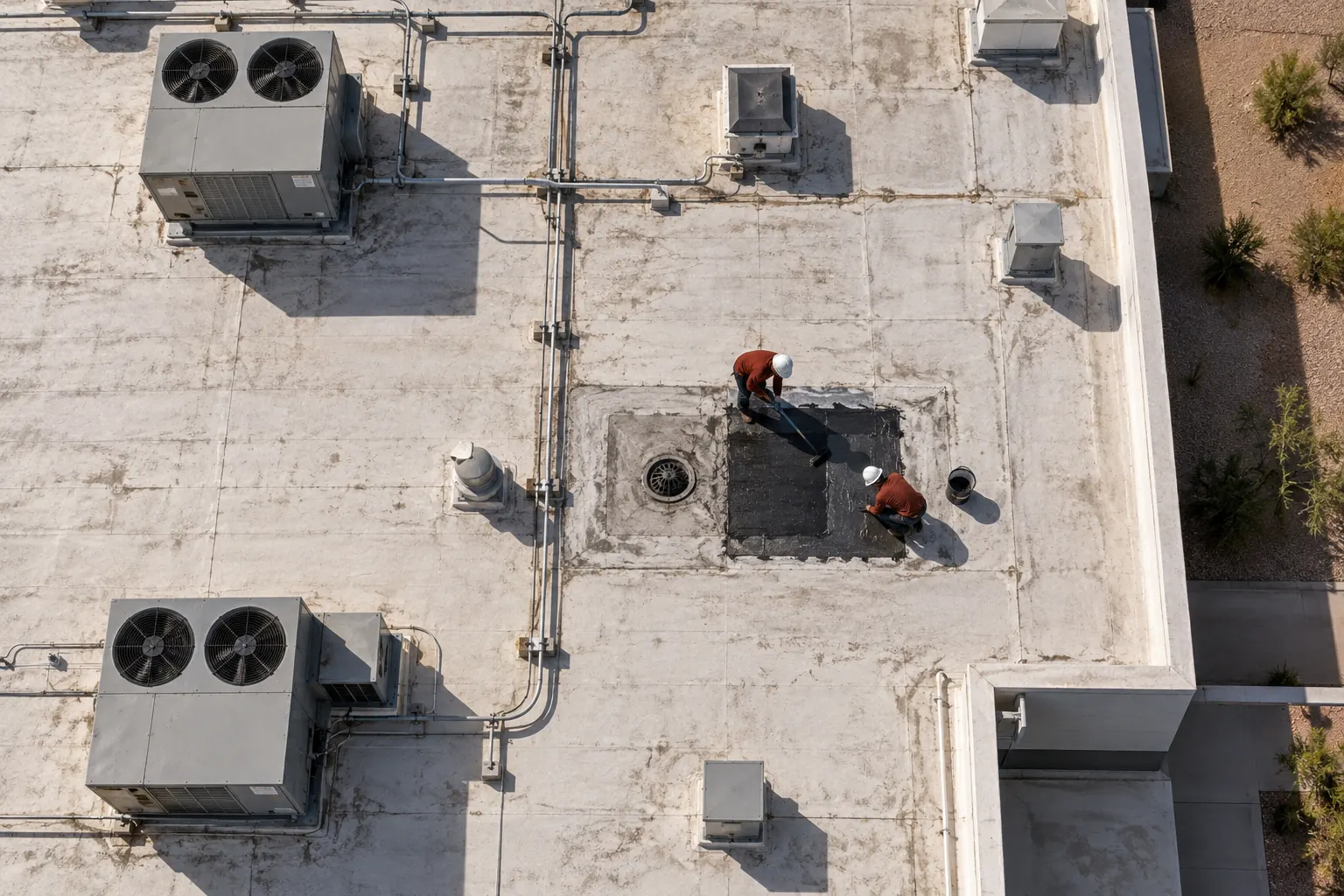
Repair holds on a flat roof when the membrane is still flexible and the insulation under the leak is dry.
On a membrane roof the weak points are where the sheet ends, turns, or gets cut for a penetration.
TPO laps are welded and EPDM laps are taped. Either one opens along its edge first, so the probe runs the full length of each lap near the leak.
The membrane is clamped into the drain bowl. Once the clamping ring cracks, water runs under the sheet and soaks the insulation around the bowl.
Inside and outside corners on unit curbs carry the most stress, and they are often where earlier patches have already been stacked.
Membrane wraps into the scupper box at the parapet. Split corners and dried sealant there send water into the wall cavity.
Where the roof meets a parapet, base flashing climbs the wall and tucks under counterflashing. Wrinkled or sagging base flashing pulls away from the wall.
Vent pipes, conduit, and gas lines pass through the membrane in boots or pitch pans that shrink and crack after a few summers.
The right repair depends on how much of the roof is involved and whether the insulation below is dry.
| Repair | What It Fixes | When It Is Enough |
|---|---|---|
| Lap repair | Lifted or open seams along a sheet edge | The sheet on both sides still flexes and bonds |
| Flashing rebuild | Split corners at curbs, walls, scuppers, and drains | Leaks trace to one or two details |
| Section replacement | Wet insulation and membrane over a defined area | Core cuts show the wet area has clear edges |
| Temporary leak control | Active water through an open lap or puncture | A short stopgap until the surface dries |
Four failures cover most flat roof leaks in Casa Grande, and each repair targets the part that let go.
A TPO weld or EPDM tape seam lets go at its edge after years of daily expansion and contraction.
We clean, prime, and re-weld or re-tape the lap, then probe it end to end before moving on.
Water bypasses the drain through a cracked clamping ring and wets the insulation in a circle around the bowl.
Wet insulation around the bowl comes out, new board goes in, and the membrane is clamped back with fresh sealant.
Base flashing sags off the parapet wall, and wind-driven rain gets behind it during monsoon storms.
Flashing is re-adhered or replaced up the wall and tucked under refastened counterflashing.
A patch set in a low spot sits under water after every storm and peels sooner.
The repair is extended past the ponding ring, and the drain path is cleared so standing water has a way off the roof.
Standing water at a drain usually means a clogged strainer or a low spot in the deck. Call and tell us how long the water stays after the rain stops.
Five steps, from finding the failed lap or flashing to the photos of the finished repair.
We identify the membrane, probe every lap near the leak, and check the drains, curbs, and wall flashing. A core cut beside the leak shows whether the insulation is still dry.
On The Roof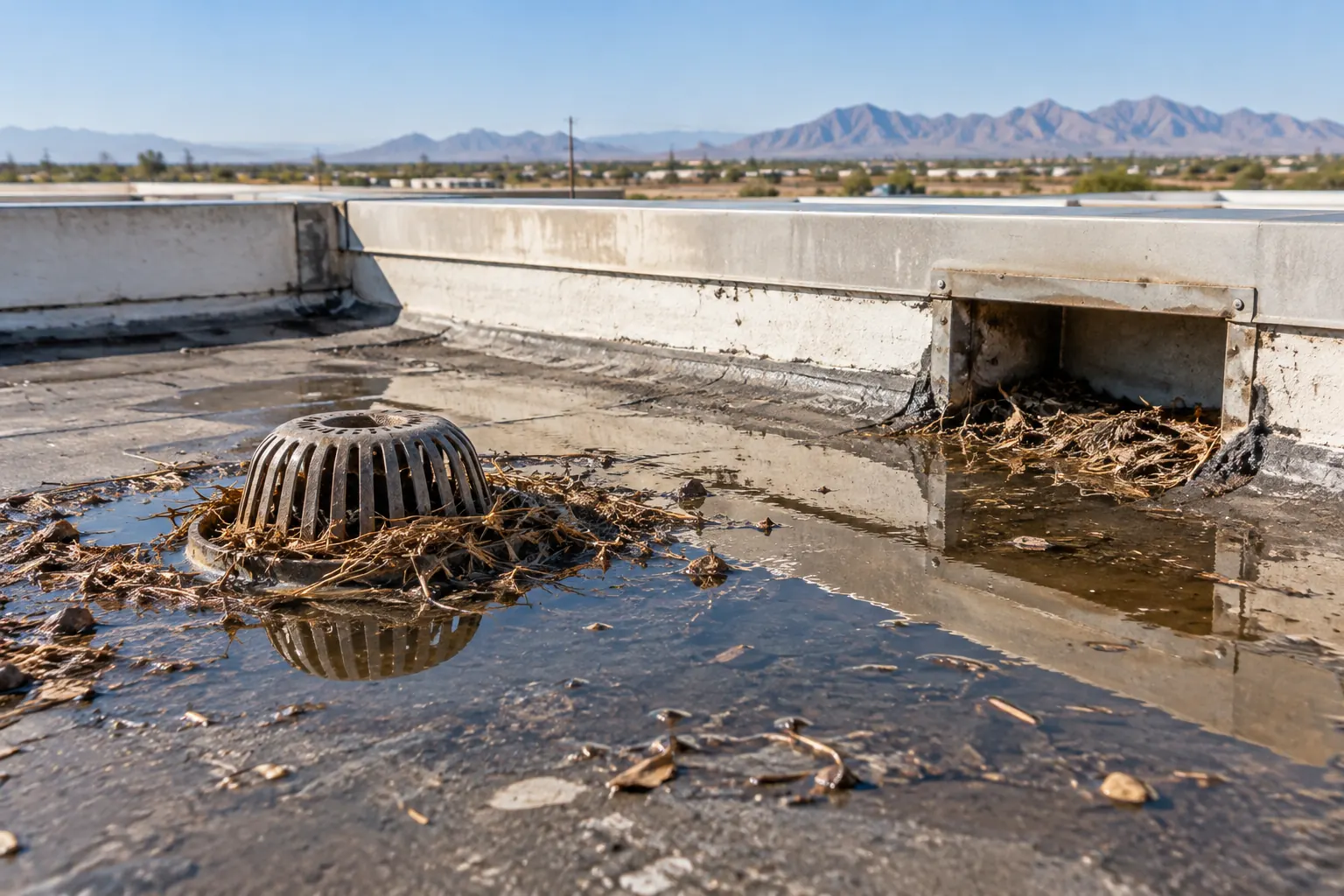
Packed strainers and scupper boxes get cleared first, so standing water drains away and the surface around the repair can dry out.
On The RoofAny wet insulation under the leak is cut back to dry board, and the opening gets new insulation and cover board before the membrane goes back on.
On The RoofLaps are welded on TPO, taped on EPDM, or patched in plies on built-up roofs, and flashings are rebuilt at curbs, walls, and drains.
On The Roof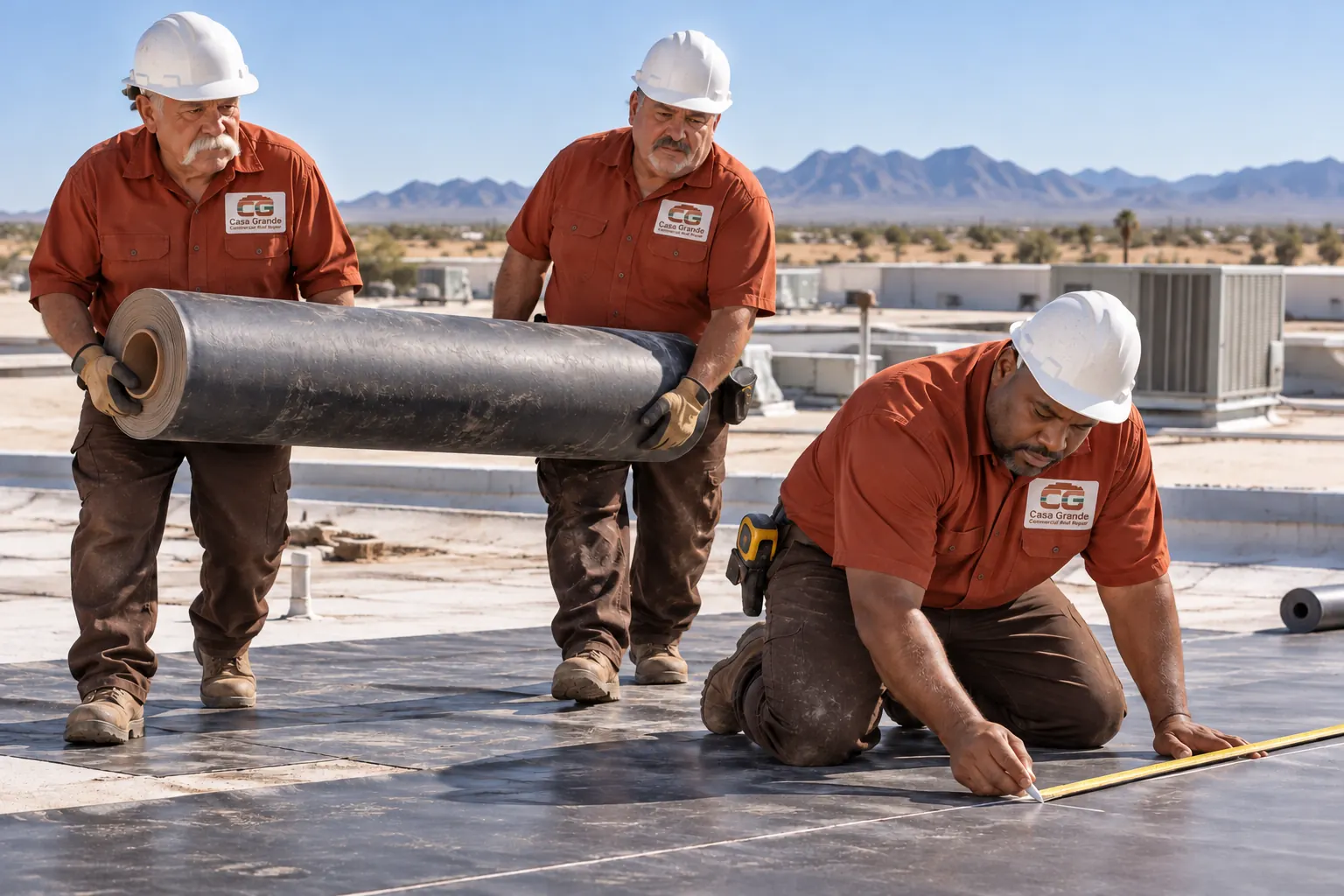
Every new lap is probed end to end, and photos of each repaired detail come to you with notes on any area that needs watching.
PaperworkTwo other services come up often once a flat roof is opened.
When the stain inside sits several bays away from any obvious flaw, leak tracing finds the lap or flashing before the flat roof repair begins.
Commercial roof leak repair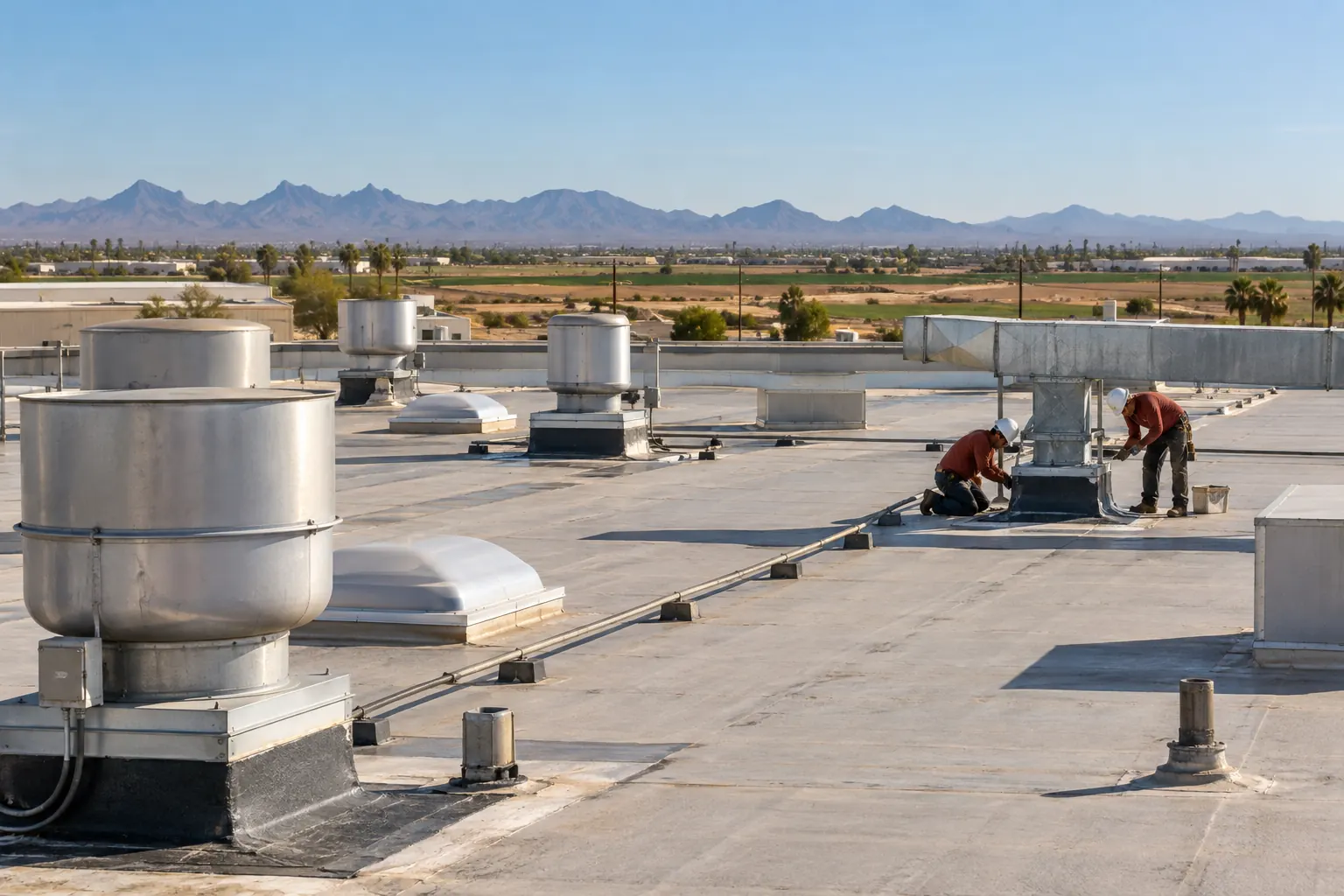
Flat roofs on plants carry exhaust fans and process ducts, so industrial roof repair adds work zones and lockout around that equipment.
Industrial roof repair around production schedulesWhat owners ask most about low-slope membrane repairs.
At the joints and edges far more than in the open field of the membrane. Daily heat swings stretch seams, drain clamping rings, scupper wraps, curb flashing, parapet coping, and pipe boots until one of them opens. Those six details are where a flat roof inspection here starts, and where most repairs end up.
Yes, in most cases. TPO from different makers can usually be welded together once the old sheet is cleaned and a sample weld holds. Very old or chalky TPO sometimes refuses to weld, and then a compatible tape or cover strip is used at the lap instead.
No. EPDM is a rubber sheet joined with primer and seam tape, while TPO is a thermoplastic joined with hot air. Each takes its own patch material, primer, and flashing, so the inspection notes which one is on the roof before repair materials are ordered.
Moisture or air trapped between the plies expands in the heat and lifts the layers above it. Small blisters with no cracks can be watched. Cracked or growing blisters get cut open, dried, and patched in plies, and a core cut nearby checks whether the moisture has spread.
It depends on how much of the roof is involved. A single lap or drain repair is a short job once materials are on the roof, while cutting out wet insulation, replacing board, and rebuilding flashing over a section takes longer. Weather, access, and tenant hours shape the schedule given after the inspection.
They make sense near rooftop units. Pads along the path HVAC technicians use protect the membrane from boots and dropped tools, which are common causes of punctures around equipment. They are welded or adhered to the sheet so they stay put in monsoon wind.
Sometimes. A reflective coating over a repaired, firmly adhered membrane can slow surface aging and help keep the roof cooler. Coating goes on only after every lap and flashing is fixed and the surface is clean and dry, and the product has to be compatible with the membrane type.
Tell us the membrane type if you know it and where water is showing up, and we will set up the inspection.