Commercial Roof Repair Questions In Casa Grande
Casa Grande Commercial Roof Repair fixes leaking flat, metal, and industrial roofs on commercial buildings in Casa Grande, plus Coolidge, Eloy, Florence, Maricopa, Arizona City, and Stanfield.
Repairs Cover Seams, Drains, And Storm Damage
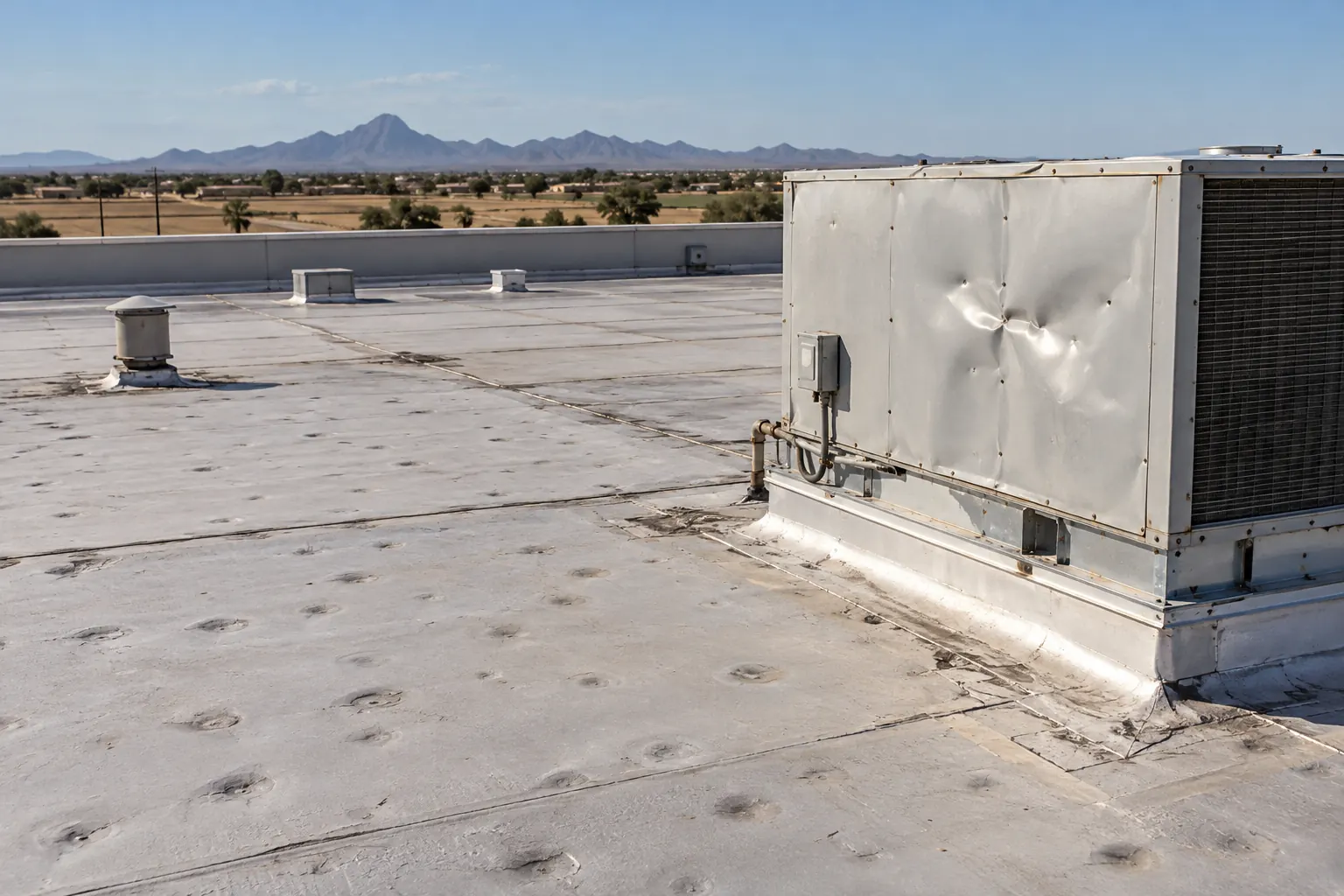
Repairs cover seams, drains, flashings, fasteners, and storm damage. Call with your roof question.
Casa Grande Commercial Roof Repair Questions By Topic
Every question below comes with a direct answer and the sources behind the local facts.
- Where Roofs Leak
- Heat, Monsoon, And Storms
- Repair Or Replace
- Permits, Taxes, And Utilities
- Areas And Getting Started
Where Roofs Leak
Where do flat commercial roofs in Casa Grande usually leak?
Most flat roof leaks start at a joint or an edge, rarely in the open field of the membrane. Hot afternoons and cool nights stretch those joints every day, so they open first.
- Seams that have lifted or lost adhesive
- Drains with cracked clamping rings or dried sealant
- Scuppers where the membrane wraps through the wall
- Curbs under rooftop units and exhaust fans
- Parapet walls with split coping or loose counterflashing
- Pipe boots and pitch pans that have pulled away
More on flat roof repair in Casa Grande.
Why is the ceiling stain far from where water enters the roof?
Water travels before it shows up inside. On a low-slope roof it can slip under a seam, run along the top of the insulation or down a steel deck flute, and drip through a ceiling tile or light fixture well away from the entry point.
Tracing it means working upslope from the stain, checking the flashings and seams above it, and running a controlled water test on one suspect detail at a time. More on commercial roof leak repair.
Can you stop an active roof leak before the permanent repair?
Yes, temporary leak control is often the first step when water is coming through. A crew can seal an open seam with compatible tape, set a patch over a puncture, clear a clogged drain or scupper, or cover a damaged area until the surface is dry enough for a lasting repair.
Treat that work as a stopgap. Tape and mastic break down fast on a hot roof, so the permanent fix should follow soon after.
What breaks down on commercial metal roofs around Casa Grande?
Fasteners and laps cause most commercial metal roof repair calls on shops, warehouses, and farm buildings here. Daily expansion in the heat works screws loose, and the rubber washers under them dry out and crack.
- Backed-out fasteners get replaced with oversized screws and new washers.
- Panel laps get cleaned and resealed where old sealant has shrunk.
- Rust bloom gets wire-brushed, primed, and coated before it eats through.
- Skylight panels that have yellowed or cracked get swapped for matching profiles.
More on commercial metal roof repair for shops and warehouses.
Can you repair an industrial roof without stopping production?
Usually, yes. Industrial roof repair gets planned around your schedule, with work zones set away from active exhaust stacks and fresh-air intakes.
Crews coordinate lockout on fans or equipment they need to lift or work beside, and they check the membrane around exhaust outlets, where grease, heat, or chemical residue softens it. On large plants and distribution buildings near the I-10 and I-8 interchange, repairs often run section by section during cooler morning hours. More on industrial roof repair around production schedules.
Heat, Monsoon, And Storms
How does Casa Grande's desert climate wear out a commercial roof?
Heat and UV do most of the damage, and monsoon storms finish the job. Long stretches of triple-digit sun dry out sealants and mastic, chalk coatings, and make older membranes brittle.
Big swings between afternoon and overnight temperatures open seams and pull flashings loose. From June 15 through September 30, the National Weather Service counts monsoon season, when downburst winds can top 40 mph and lift weakened edge metal.
What should I check on my roof after a monsoon storm or high wind?
Start with the perimeter and the drains, since wind and dust hit those first. Walk the roof only when it is safe, or have a roofer do it.
- Edge metal and coping that has lifted or lost fasteners
- Drains and scuppers packed with dust, leaves, or debris
- Flashing torn at curbs and parapet walls
- Ponding rings that show water sat longer than usual
- Interior ceiling stains that appeared after the storm
How should I document storm damage for an insurance claim?
Photograph everything before anything gets cleaned up or patched. Take wide shots that show where the damage sits on the roof, then close-ups of torn flashing, lifted seams, dented panels, or displaced edge metal.
Note the storm date, and photograph interior ceiling stains and wet stock too. Keep receipts for any temporary leak control. Your insurer decides coverage, so call early and ask what records the adjuster wants.
Repair Or Replace
Should I repair or replace a leaking commercial roof?
It depends on what sits under the membrane. Repair fits when leaks are isolated and the insulation stays dry. Replacement becomes the better call in these cases.
- Wet insulation spreads across large sections, found by core cuts or a moisture scan.
- Deck damage shows up as rusted steel flutes or soft spots underfoot.
- Age has caught up, with seams failing all over the roof.
- Patches keep giving out in the same areas season after season.
How long does a commercial roof repair last?
A good repair lasts as long as the material around it holds up. A new seam on an otherwise healthy membrane can go many years, while a patch on brittle, sun-cracked membrane gives out much sooner.
Drainage matters too, since a ponding ring around a repair keeps stressing it. Compatible materials, clean surface prep, and regular drain clearing do the most to keep a repaired flashing or seam watertight.
What affects the cost of commercial roof repair?
Access, roof system, and how far the water has spread drive cost the most. These are the factors an inspection sorts out.
- Roof type, such as TPO, EPDM, built-up, modified bitumen, or metal panels
- Size and number of leak points, including seams, curbs, and drains
- Wet insulation or deck damage found under the surface
- Height, roof hatch access, and any lift or crane needs
- Work hours set around tenants or production
What maintenance keeps a flat commercial roof from leaking?
Two inspections a year catch most problems early, one in spring before monsoon season and one in fall after it. Each visit should clear drains and scuppers, reseal pitch pans and pipe boots, check seams and parapet flashings, and look for damage left by HVAC service crews.
Washing dust off a white membrane or coating helps it stay reflective. A simple log of each visit, with photos, shows which details keep coming back.
Permits, Taxes, And Utilities
Do I need a permit for commercial roof repair in Casa Grande or nearby towns?
It depends on the scope of work. Larger repairs and reroofing go through the local building authority, and each jurisdiction sets its own threshold, so call the office that covers the property before a crew opens the membrane or deck.
Location Jurisdiction Who issues permits Casa Grande Incorporated city City of Casa Grande Planning & Development (plan review application) Coolidge Incorporated city City of Coolidge building department Eloy Incorporated city City of Eloy Building Official (building code) Florence Incorporated town Town of Florence Community Development (department page) Maricopa Incorporated city City of Maricopa Building Safety (Building Safety) Arizona City Unincorporated Pinal County Building Safety (Building Safety) Stanfield Unincorporated Pinal County Building Safety (Building Safety) Properties on tribal land follow that community's own permitting rules.
Does historic review apply to roof repairs in Casa Grande or Florence?
Yes, for designated landmarks and for buildings inside historic districts in both places. Casa Grande's Certificate of No Effect or Appropriateness packet counts a change in roofing material as an alteration, while routine repair and upkeep follow a separate path.
In Florence, the Historic District Advisory Commission reviews district work under guidelines covering roofs. Parapet caps, awnings, and visible metal panels draw the closest look.
Can commercial roof work qualify for Section 179?
Roofs on existing nonresidential buildings, such as warehouses, plants, stores, and offices, are among the improvements a business can elect to expense. For 2026, the limit is $2,560,000, per IRS Publication 946.
Residential rental buildings are excluded. Small fixes to a seam, drain, or flashing get handled differently on a return than a full roof replacement, so talk with your CPA before scheduling larger work.
Are there utility programs that help pay for reflective roof work near Casa Grande?
Check with your electric provider first, because business programs open, close, and change terms often, and none is ever certain. Service around Casa Grande comes from APS, SRP, or a local electrical district, based on the property's location.
Where an offer exists, it often requires a membrane or coating listed by the Cool Roof Rating Council and approval before work starts. Treat any rebate as a bonus on top of the repair.
Areas And Getting Started
What areas do you serve?
We repair commercial roofs in Casa Grande and six nearby communities.
- Casa Grande: flat roofs on distribution buildings near I-10 and I-8
- Coolidge: repairs permitted by the City of Coolidge
- Eloy: roofs along the I-10 corridor, under the City of Eloy Building Official
- Florence: downtown historic district buildings subject to commission review
- Maricopa: buildings along State Route 347, under city Building Safety
- Arizona City: unincorporated, so Pinal County issues permits
- Stanfield: metal farm and shop buildings in rural Pinal County
How do I get started?
Call us at (623) 310-0222 or request a free estimate to set up a free roof inspection. On the roof, the inspector looks at these details.
- Seams, laps, and flashings at walls and curbs
- Drains, scuppers, and ponding rings
- Membrane blisters, cracks, and rust bloom on metal panels
- Fasteners, skylight panels, and edge metal
- Moisture under the surface wherever leaks have shown inside
Afterward you get photos and a plain explanation of what needs repair now and what can wait.
Sources
- IRS Publication 946, How To Depreciate Property
- National Weather Service Tucson, Monsoon Safety
- City of Casa Grande, Standard Plan Review Application
- City of Casa Grande, Certificate of No Effect / Appropriateness packet
- City of Eloy, Building Code Administration
- Town of Florence, Community Development
- Town of Florence, Historic District Advisory Commission agenda packet
- City of Maricopa, Building Safety
- Pinal County Building Safety
- Cool Roof Rating Council, Rated Products Directory
Still Have A Roof Question?
Call and ask, or request a free estimate and the inspection answers it on your roof.