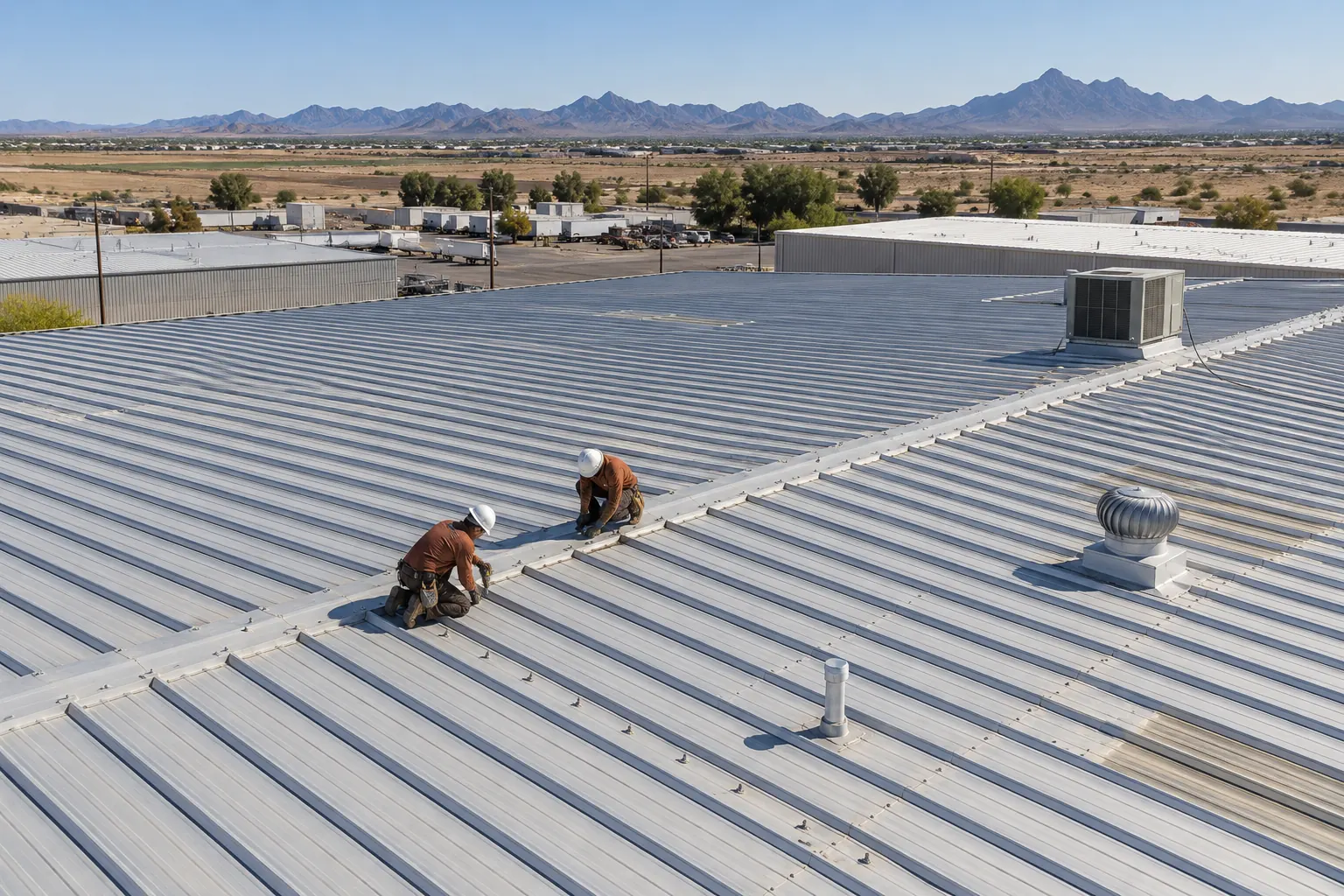
Commercial Metal Roof Repair
Many plants and warehouses here pair a flat roof with metal sections over shops, and metal roof repair handles their fasteners, laps, and skylights.
Commercial metal roof repair
We handle industrial roof repair on Casa Grande plants and distribution buildings, working around exhaust stacks, process ducts, fresh-air intakes, and production schedules.
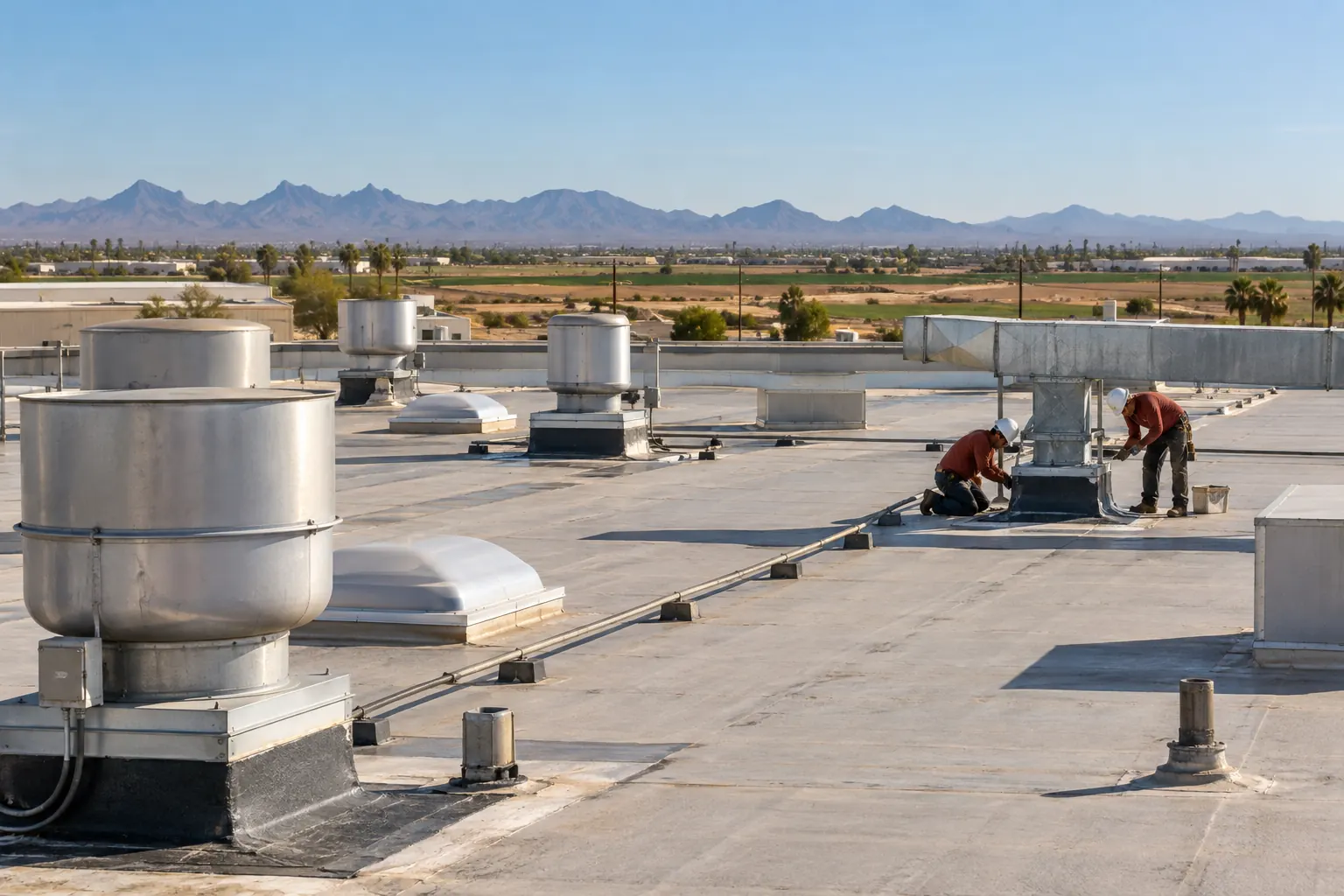
Large roofs are usually repaired one section at a time. These signs show whether that approach fits your building.
Heavy equipment and constant service traffic concentrate damage in predictable places on a plant roof.
Heat, grease, and process residue from exhaust outlets soften the membrane around the fan, and it splits or blisters there first.
Duct supports sit on pads or stands that wear through the sheet, and duct penetrations need flashing that moves with the duct.
Large curbs under makeup air units carry flashing that technicians step on and pry against during filter changes.
Technicians walk the same paths to equipment, wearing the membrane thin wherever walkway pads are missing.
Wide plant roofs move a lot of water to few drains, so a clogged strainer floods a large area quickly.
Curbed skylights and smoke vents add more flashed openings, and their lids and lenses crack in the sun.
Industrial repairs are scoped by roof zone so production areas below stay protected.
| Repair | What It Fixes | When It Is Enough |
|---|---|---|
| Exhaust-zone rebuild | Membrane softened or split around exhaust outlets | Damage stays near the equipment |
| Curb and support reflashing | Leaks at makeup air units, fans, and duct supports | Curbs and supports are structurally solid |
| Walkway pad installation | Worn membrane along service routes | The sheet under the walkway is still intact |
| Section-by-section repair | Larger areas with dry insulation around them | Production allows one zone at a time |
Four repairs cover most of the leaks that reach production floors in Casa Grande plants.
Grease and heat from exhaust outlets break down the membrane until it splits around the fan curb.
The damaged area is cut out and rebuilt with membrane suited to that exposure, and the fan curb is reflashed.
Vibration from large fans and units works curb flashing loose, and leaks land on the production floor.
Curb flashing is rebuilt and fastened under the counterflashing, with locked-out equipment lifted where needed.
Repeated foot traffic and dropped tools wear holes in the sheet between the hatch and the equipment.
Punctures are patched and walkway pads are added along the path so traffic stays on protected surface.
Dust and debris from rooftop equipment pack the few drains on a wide roof, and water backs up over the flashing.
Drains are cleared and their flashing reset, and a clearing schedule ahead of monsoon season keeps the strainers working.
Call and describe what sits on the roof above the drip, such as fans, ducts, or a unit, so the right lockout and access can be planned.
Industrial repairs add a planning step for equipment, access, and production before work starts on the roof.
We walk the roof with your maintenance lead, mark damage around exhaust outlets, curbs, and service routes, and take core cuts where leaks have reached the floor below.
On The Roof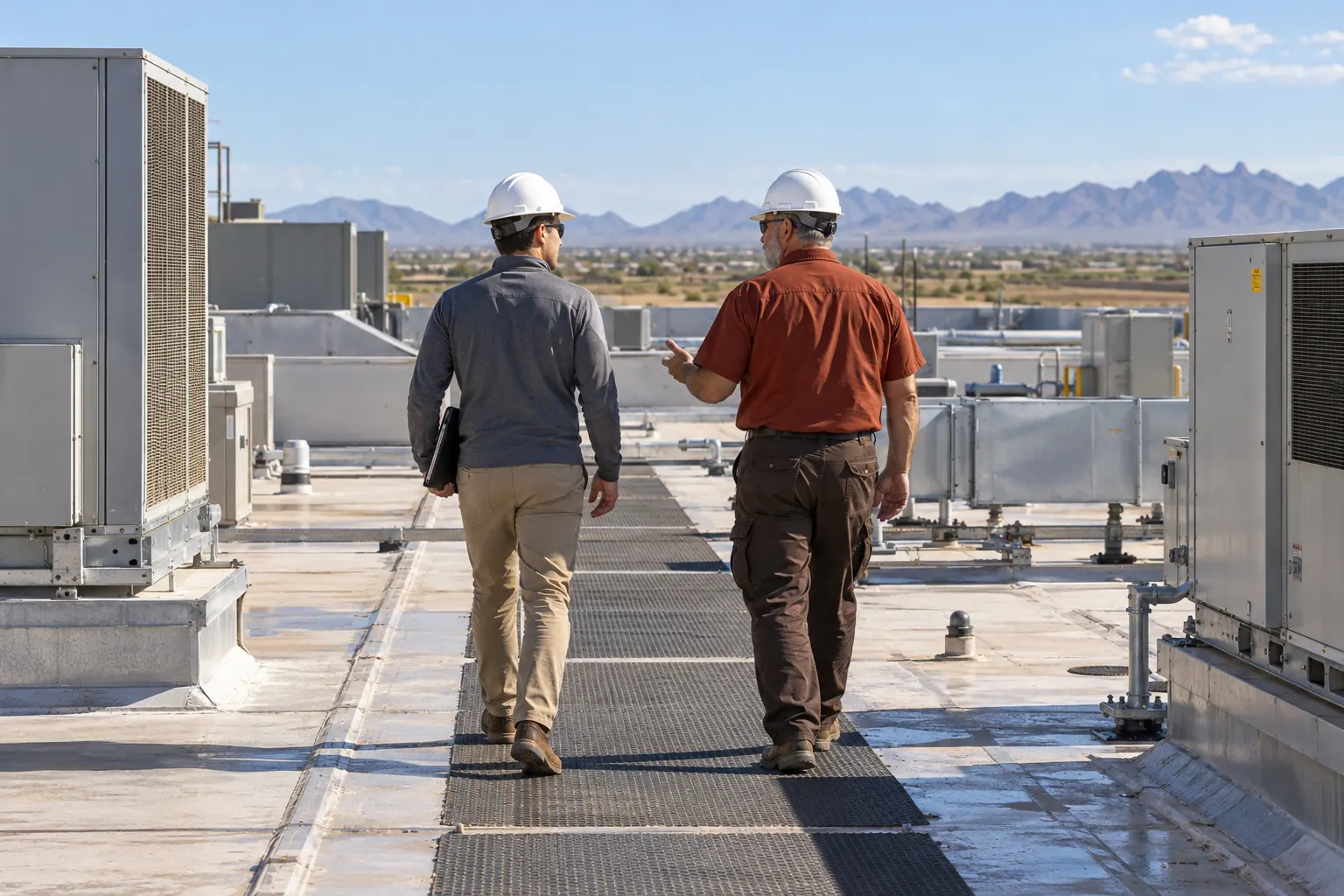
Work zones are set away from active stacks and fresh-air intakes, and fans or units that must be lifted get scheduled for lockout with your maintenance staff.
Paperwork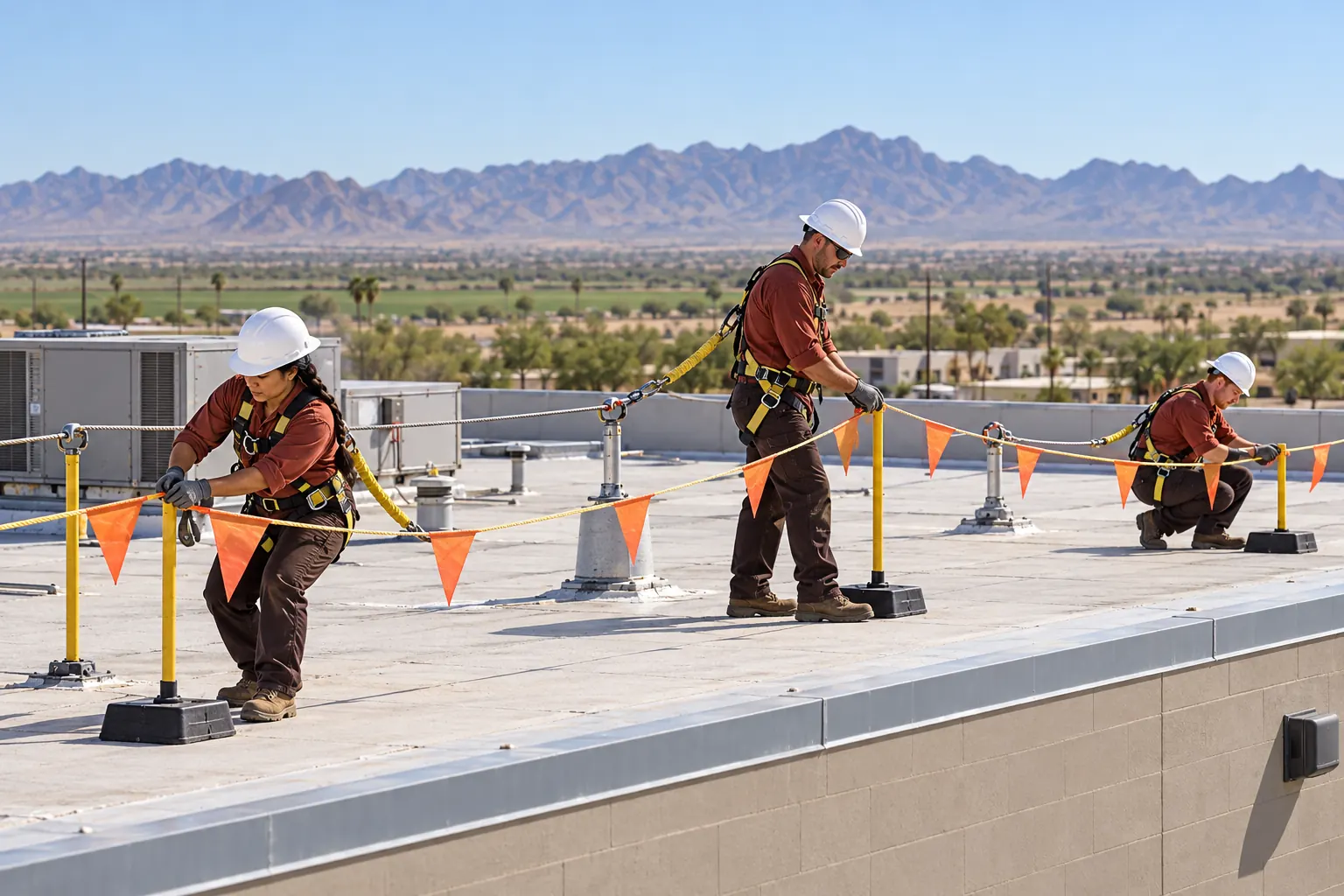
Material goes up by the approved access point, often a lift or hoist set away from doors and docks, and is staged on the roof outside traffic routes.
At The BuildingOne zone is opened, repaired, and closed before the next, often during cooler morning hours, so production areas below stay covered.
On The RoofPhotos and notes are organized by roof zone, so maintenance staff can see which areas were repaired and which need watching.
PaperworkPlant roofs often combine several roof systems on one building.
Many plants and warehouses here pair a flat roof with metal sections over shops, and metal roof repair handles their fasteners, laps, and skylights.
Commercial metal roof repair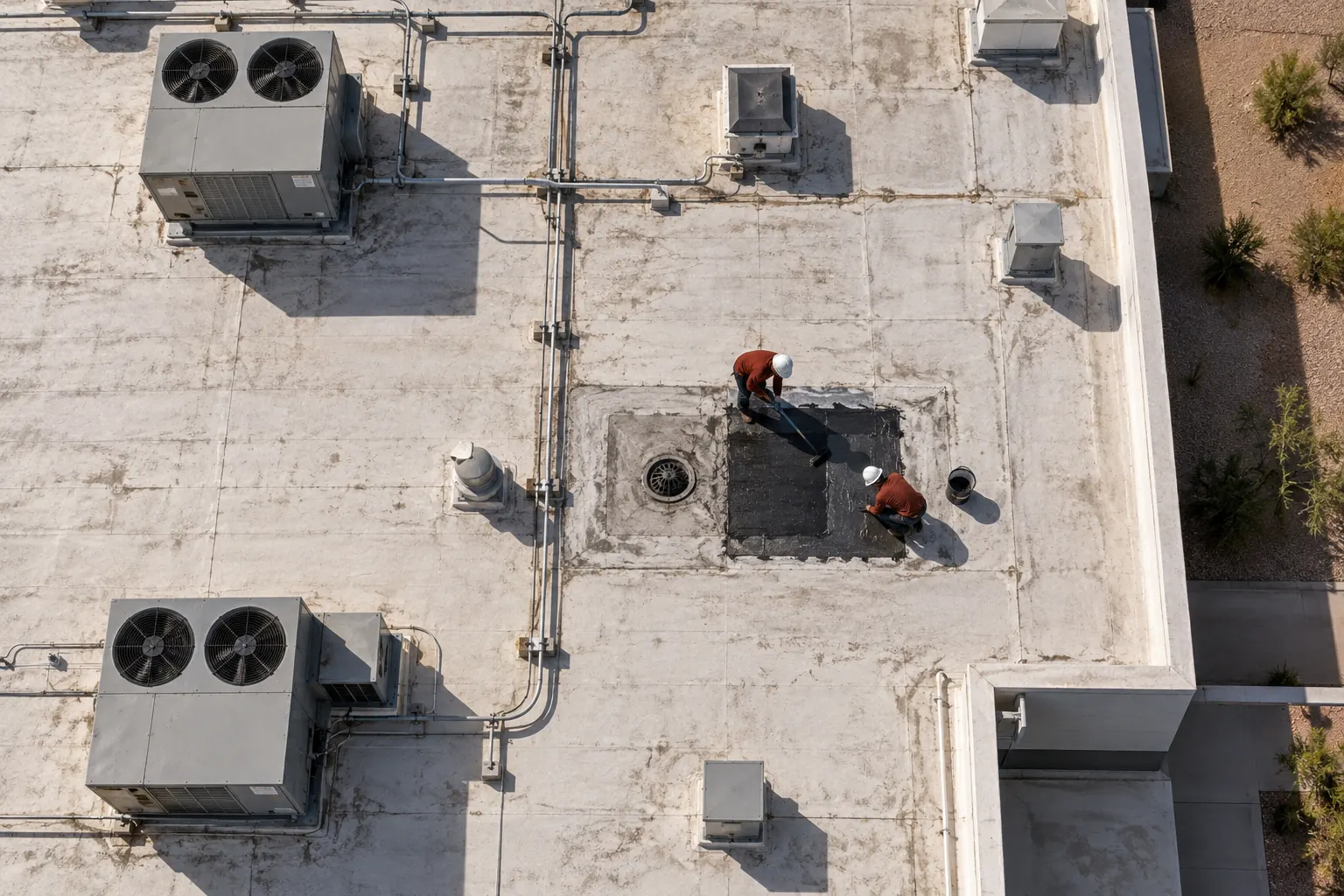
Away from the equipment, the rest of a plant roof is ordinary low-slope membrane, covered by flat roof repair at its laps, drains, and walls.
Flat roof repairWhat plant and facility managers ask before roof work starts.
In most cases, yes. Repairs are planned around your schedule, with work zones kept away from active exhaust stacks and fresh-air intakes, and lockout arranged for any fan or unit that must be lifted. On large plants and distribution buildings near the I-10 and I-8 interchange, sections are often repaired during cooler morning hours.
Many plants require it, and that requirement gets met before work starts. Share your site rules, sign-in process, PPE requirements, and any hot-work or confined-space policies during planning so the roofing work fits them from the first day.
Membranes vary in how they handle grease and chemical exposure, so the repair material is matched to what the exhaust carries. Grease containment at the fan also protects the roof, since grease that keeps landing on any membrane shortens its life around the curb.
Yes, with planning. Dust and debris control, sealed openings above sensitive areas, and work timed to production breaks keep contamination down. Tell us which zones below are sensitive so the repair sequence avoids opening the roof over them while they run.
Through the access point your facility approves: a roof hatch, a stair tower, or a lift or hoist set away from traffic. Heavy items are spread out so no single spot of the deck carries the load, and nothing gets staged on skylights.
On roofs with regular service traffic, yes. Pads along the paths technicians use protect the membrane from boots and dropped tools and show visitors where to walk. They cost far less than repeated puncture repairs near busy equipment.
Only the roofers and anyone your safety plan allows. Plant staff who need to reach equipment during the work are told which zones are open, and the work area is flagged off from the hatch so nobody walks into an open section.
Tell us what equipment sits on the roof and when production runs, and we will plan the inspection around it.